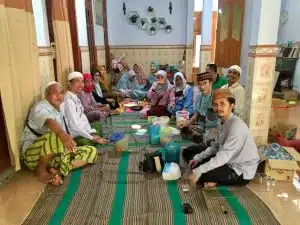
The fourth post in our alumni profile series for the 20th year of AIMEP is about Professor Abdul Mu’ti, Secretary General of Muhammadiyah, Indonesia’s second largest Islamic organisation, and an alumnus of the first ever AIMEP in 2002!
(Note: Since this story was first published, we are proud that Professor Abdul Mu’ti has been appointed Indonesia’s Minister for Primary and Secondary Education in the 2024-2029 “Red and White” Cabinet.)
Read his story below:
Abdul Mu’ti
I was born to a humble farming family in a remote village near Kudus, in the coastal area of Central Java. Because this area has a history of tolerance between different religions, a form of Islam developed there which has a very strong respect for local traditions. For example, as the cow is considered to be a holy animal for Hindus, the Muslim tradition is to slaughter buffalo rather than cows. This was the first influence in my life.

Another influence I had was that when I was a child, one of my teachers would teach us English after our congregational prayers, and these lessons inspired me to listen to international radio stations like Radio Australia and the BBC, and to watch the TV world news in English. This was a bit unusual for a boy of my age, and it made me dream of one day travelling to other parts of the world, to meet people from different cultural and religious backgrounds.
After finishing my primary school studies, I went on to study in an Islamic junior high school about eight kilometres from my home, and this gave me my first experience of interacting with students from different cities and family backgrounds.

Next, I went to high school, Madrasah Aliyah, where one of my teachers was very inspiring. He introduced me to poetry, and eventually, I began to write poetry myself and even to read some of my poems on the radio. This experience helped me to understand the importance of culture, writing and imagination.
After school, I studied at the Islamic University of Semarang, where I met with students from many different cultural backgrounds, as well as lecturers and visitors from many different countries. I was also able to further improve my English! Apart from my normal student activities, I was actively involved in the Muhammadiyah University Students’ Association, and this allowed me to improve my leadership skills, as well as my religious understanding.
I then fulfilled my dream of studying abroad by obtaining a Master’s degree from Flinders University in South Australia. When I returned, I began to teach in the Islamic University in Semarang, and I was also elected Chairman of Muhammadiyah Youth in Central Java. Next, I began a PhD at the Islamic universities of Semarang and Jakarta.

In July 2002, I was nominated as a candidate for Chairman of the National Board of Muhammadiyah Youth. Although the competition among the candidates was very strong, I did not stay in Surabaya the day of the election, but instead decided to travel to Jakarta to take part in an interview for the Muslim Exchange Program in Australia. As I was very late, I was the last candidate to arrive! After the interview, I went back to Surabaya for the election, and to my surprise, I was actually elected, based on my experience as a former youth leader.
In September 2002, my friend and I were selected as the pioneer participants of the Muslim Exchange Program. It was a very interesting experience for me. Firstly, I realised that Australian Muslims come from many different countries, including Middle Eastern countries such as Egypt and Lebanon, and also that their culture and traditions are different to ours in Indonesia.
I was also asked to deliver a speech to the Australian Army in Melbourne, the day after the terrible suicide bombing in Bali. That was a tragic moment for me as an Indonesian, and it was difficult for me to know what I should say. First of all, I expressed my sorrow to all Australian people. And secondly, I said that this bombing was contradictory to the teaching of Islam, that jihad is not killing innocent people, that it is instead the struggle to save the lives of people.
Another thing that happened was that I was interviewed for Radio Australia, which was a special moment for me. Before we went live, the interviewer commented on my good English and when I told him about listening to Radio Australia in my childhood, he got quite emotional. Then he introduced me as the Chair of Muhammadiyah Youth, an organisation with 10 million members, who had started learning English as a child on Radio Australia.

I believe that bringing Muslim leaders from Indonesia to Australia is very beneficial for both countries. This experience really enriched my understanding about Australia as a multicultural country. It also made me feel that Australia is my second home! As a result, I’m very happy to be involved in many initiatives to bring Indonesia and Australia closer, especially in the areas of education, religion and culture. Being confident with multiculturalism and pluralism is very important for me, and I believe that these are factors which help to create a peaceful world.
With the help of my younger brother and the Muhammadiyah communities in my area, we recently set up a multilingual kindergarten and primary school in my village. My dream is to provide the younger generation with access to the rest of the world through learning English. To inspire the children, we have painted the walls of the kindergarten with images of the Wonders of the World, as well as inviting speakers from South Korea to come to the inauguration!
I hope my personal experience of becoming a world citizen can also become the journey of the children in my village. I want to encourage them, to help them see that even if they come from a humble family of farmers like me, they can succeed in life if they have a dream, work hard, and study.

Professor Abdul Mu’ti
Jakarta, Indonesia
AIMEP 2002
Photographer: Ferry Yanuar